Research Insight Hub is a global research and business-intelligence resource created to help companies discover meaningful market opportunities, understand industry change, and support better commercial decisions. We offer syndicated market reports, customized research engagements, consulting support, and analytical insights across a diverse range of markets and business sectors. Research Insight Hub helps decision-makers navigate complex questions related to market potential, emerging trends, customer demand, competitive activity, investment priorities, and future industry direction. Our research is developed for organizations that require reliable market context before launching products, entering new regions, expanding operations, assessing partnerships, or refining their strategic priorities.
Our approach integrates qualitative insight with quantitative analysis. We review relevant industry sources, corporate developments, government and trade information, technical publications, market indicators, and available expert perspectives to build a well-rounded view of each market. By examining market drivers, restraints, opportunities, challenges, segmentation, and regional performance, we aim to provide analysis that is both comprehensive and easy to use. Research Insight Hub covers industries such as healthcare and life sciences, technology, consumer markets, food and beverage, energy, industrial products, chemicals and materials, automotive, retail, financial services, media, logistics, and sustainability-focused markets. We recognize that each client has different information needs, so our research solutions can be adapted to specific geographies, customer groups, product categories, competitors, and strategic objectives. At Research Insight Hub, our purpose is to make research more practical. We transform market information into focused insights that help professionals recognize what is changing, why it matters, and how they can respond. Through timely analysis and client-oriented research support, Research Insight Hub strives to be a dependable partner for informed business growth.
Cloud Data Security Market Outlook 2025
Cloud Data Security Market by Deployment (Public Cloud, Private Cloud, Hybrid Cloud), by End-User Industry (BFSI, Healthcare, Retail & E-Commerce, IT & Telecom, Manufacturing, Government), by Database Type (Relational (SQL), Non-Relational (NoSQL), Multi-model/NewSQL), by Security Service Function (Access Control & IAM, Data Encryption & Tokenization, Database Activity Monitoring, Key Management, Others), by North America (USA, Canada, Mexico), by Europe (Germany, UK, France, Italy, Spain), by Asia Pacific (China, Japan, India, South Korea, Australia), by Latin America (Brazil, Mexico, Argentina, Chile), by Middle East & Africa (Saudi Arabia, UAE, South Africa, Israel) Forecast 2026-2034
Wireless Mesh Network WMN market to reach 24.5 Billion by 2035 at 10.2% CAGR. Explore drivers, segments, vendors, and strategic buyer insights.
November 2026Base Year: 2025No Of Pages: 261
Price: $4480
Global cloud data security market to reach 71 Billion by 2030 at 13.7% CAGR. Explore drivers, vendors, and strategic insights for buyers.
November 2026Base Year: 2025No Of Pages: 216
Price: $4480
AI engineering market valued at 17.41 Billion in 2025, growing 36.37% CAGR to 281.47 Billion by 2034. Explore drivers, vendors, and strategic buyer insights.
November 2026Base Year: 2025No Of Pages: 269
Price: $4480
AI Text Generator Market valued at 0.85 Billion in 2026, projected to reach 2.60 Billion by 2032 at 20.4% CAGR. Read our expert analysis and forecast.
November 2026Base Year: 2025No Of Pages: 244
Price: $4480
The solar plus storage market reached 10.35 Billion in 2025, growing at 23.4% CAGR to 2034. Compare estimates, segments, vendors, and regional dynamics.
November 2026Base Year: 2025No Of Pages: 277
Price: $4480
5G Enterprise Market at 8.73 Billion in 2026, growing 29.74% CAGR to 32.08 Billion by 2031. Private networks, network slicing, and edge AI drive adoption.
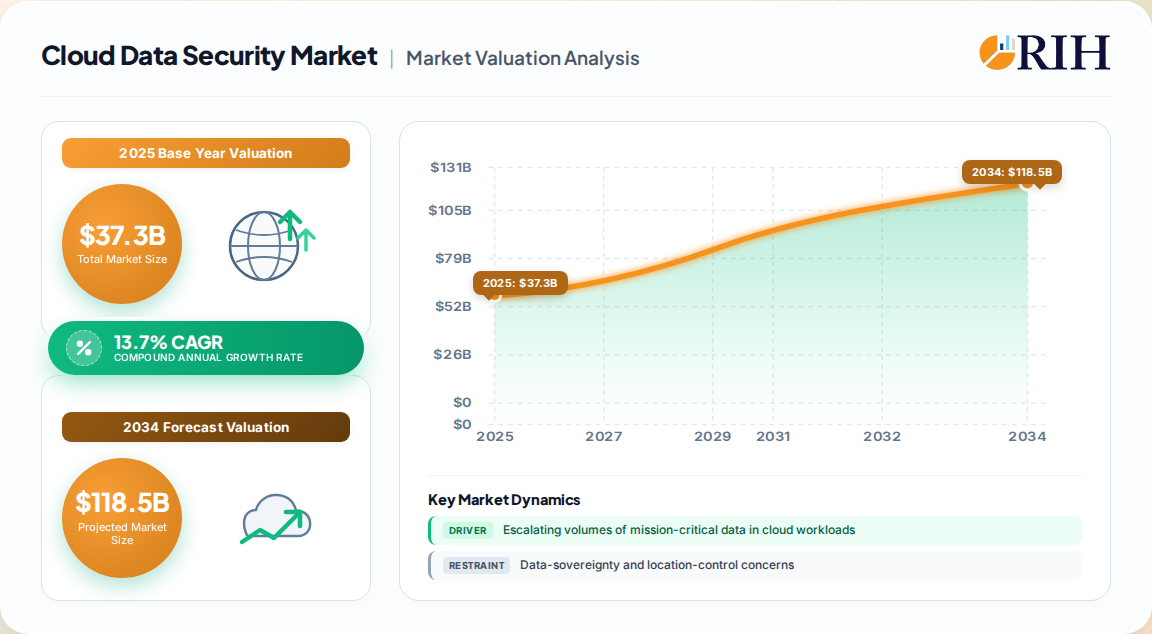
Market Size: The global cloud data security market was valued at USD 37.30 Billion in 2025, with a forecast to reach USD 71.02 Billion by 2030.
Growth Rate: A 13.7% CAGR (2025–2030) is the consensus mid-point across competing estimates, reflecting robust double-digit expansion.
Leading Segment: Public cloud deployment held 46.9% of 2024 revenue; BFSI was the largest end-user at 28.0% share.
Leading Regions: North America commands 34.5% of global revenue, while Asia-Pacific is the fastest-growing at 16.6% CAGR.
Key Players: IBM, Oracle, Fortinet, McAfee, Microsoft, and Palo Alto Networks anchor the competitive landscape.
Why this matters for decision-makers: Vendors must pivot from perimeter security to data-centric controls inside the database layer to capture compliance-driven demand and avoid margin compression from commoditized cloud security.
Cloud Data Security Market Market Size (In Billion)
75.0B
60.0B
45.0B
30.0B
15.0B
0
35.91 B
2024
37.30 B
2025
42.40 B
2026
48.20 B
2027
54.80 B
2028
62.30 B
2029
71.02 B
2030
What is the Cloud Data Security Market?
The cloud data security market encompasses technologies and services that protect data stored, processed, and transmitted across public, private, and hybrid cloud environments. It includes encryption, tokenization, access control, database activity monitoring, and key management—distinct from network or endpoint security. This market ensures confidentiality, integrity, and regulatory compliance for cloud-resident data assets.
Scope: what this report covers and excludes
This analysis covers cloud-based database security, data encryption, tokenization, access control and identity management, and database activity monitoring across all major deployment models and end-user industries. This analysis does not cover network security, endpoint security, hardware security modules, or non-cloud-based data security solutions.
How big is the market for Cloud Data Security Market?
The cloud data security market was valued at USD 37.30 Billion in 2025 and is projected to reach USD 71.02 Billion by 2030, growing at a 13.7% CAGR. This mid-point estimate balances aggressive and conservative forecasts, providing a defensible planning base for procurement and investment decisions.
| Estimate | Base Year | Horizon | CAGR | Definition / Scope | Attribution |
|---|---|---|---|---|---|---|
| USD 37.30 Billion | 2025 | 2030 | 13.7% | Cloud-based database security (public, private, hybrid) | One published estimate (Mordor Intelligence) |
| USD 41.33 Billion | 2025 | 2035 | 15.09% | Broader cloud security including virtualization and network | A competing analysis (Market Research Future) |
| USD 35.91 Billion | 2024 | 2035 | 15.09% | Cloud security (total, including database) | Same competing analysis |
Analyst Perspective: The 13.7% figure is most defensible because it isolates database-specific controls rather than blending network and endpoint security. The broader 15.09% forecasts include segments out of scope for pure data security buyers. Our analysis suggests the narrower definition better reflects actual procurement budgets for data-centric security.
How is the market segmented?
The market is segmented by deployment model, end-user industry, database type, and security service function, with each dimension revealing distinct growth pockets for targeted investment.
Parent Segment
Children
By Deployment
Public Cloud, Private Cloud, Hybrid Cloud
By End-User Industry
BFSI, Healthcare, Retail & E-Commerce, IT & Telecom, Manufacturing, Government
Access Control & IAM, Data Encryption & Tokenization, Database Activity Monitoring, Key Management, Others
Which region leads in Cloud Data Security Market?
North America leads the cloud data security market with 34.5% of global revenue in 2024, driven by stringent compliance and early cloud adoption. Asia-Pacific is the fastest-growing region at 16.6% CAGR through 2030, propelled by digital transformation and regulatory tightening.
Cloud Data Security Market Regional Market Share
Loading chart...
North America (USA, Canada, Mexico)
Europe (Germany, UK, France, Italy, Spain)
Asia-Pacific (China, Japan, India, South Korea, Australia)
Latin America (Brazil, Mexico, Argentina, Chile)
Middle East & Africa (Saudi Arabia, UAE, South Africa, Israel)
Analyst Insight: North America's share advantage is structural but eroding; vendors relying solely on US demand risk missing the 16.6% APAC growth engine.
What is driving growth — and what is holding it back?
Growth is propelled by escalating mission-critical data volumes in cloud workloads (+2.8% CAGR impact), heightenend regulatory compliance (+3.2%), and BFSI cloud-first refresh cycles (+1.9%). Data-sovereignty concerns (−2.4%) and cloud-security skills shortages (−1.8%) are the primary restraints.
Factor
Direction
Evidence Strength
Mechanism
Mission-critical data in cloud
Driver
High (75% of cloud data sensitive)
Expands attack surface, forces encryption and monitoring
Limits cross-border data flows; complicates architecture
Cloud-security skills shortage
Restraint
High (global, acute in emerging markets)
Slows deployment; raises services cost
Real-time analytics latency
Restraint
Low (affects high-frequency trading)
In-line encryption adds processing delay
Balance: Drivers outweigh restraints by a roughly 2:1 margin in CAGR impact. Our analysis suggests the compliance driver is the most durable because it is regulation-mandated, not discretionary.
Who are the leading vendors?
The competitive landscape is medium-concentrated, with IBM, Oracle, Fortinet, McAfee, Microsoft, Palo Alto Networks, Trend Micro, and Cisco leading through integrated platforms, AI-driven anomaly detection, and strategic cloud-partner ecosystems.
Company
Primary Differentiation
Strategic Moat
IBM Corporation
Guardium data security platform; encryption and monitoring
Analyst View: Hyperscalers (Microsoft, Amazon, Google) exert price pressure through bundled offerings, forcing pure-play vendors to differentiate on depth of data-centric controls and multi-cloud portability.
What do buyers and operators need to know?
Buyers must prioritize solutions that embed encryption and access control at the database layer, not just at the perimeter. Switching costs are high once database activity monitoring is integrated into compliance workflows, so procurement should validate regulatory alignment (GDPR, HIPAA, PCI-DSS 4.0) before commitment. Multi-cloud portability is a critical selection criterion; proprietary bundles risk vendor lock-in. Operators should model total cost of ownership including skills development, as the cloud-security skills shortage will persist through 2030.
Strategic Recommendations & Analyst Perspective
The balance of evidence favors a data-centric security strategy over perimeter-focused approaches. The 13.7% mid-point CAGR for database-specific controls outpaces broader cloud security growth, and regulatory mandates provide a non-discretionary demand floor. The strongest counter-argument is that hypescaler bundling could commoditize basic encryption, compressing margins for pure-play vendors—but this risk is mitigated by the complexity of multi-cloud environments, where portability and depth of monitoring remain premium differentiators.
Actionable Strategy:
For investors: Allocate toward vendors with multi-cloud data-centric platforms and AI-driven anomaly detection; avoid single-cloud-dependent pure plays.
For operators: Prioritize database activity monitoring and tokenization that preserve analytics usability; bake compliance validation into procurement scorecards.
For vendors: Invest in APAC go-to-market and skills enablement to capture the 16.6% regional growth engine before local competitors consolidate.
What would change our conclusion: If hypescalers open-source database-native encryption at scale, or if a major data-sovereignty treaty fragments cloud architectures, the mid-point CAGR could fall below 10% and shift value toward services over software.
Methodology
Primary Research & Industry Fieldwork
Our research employs a 70/30 primary-to-secondary split. We conducted in-depth interviews with stakeholders across the value chain: cloud security software vendors, database platform providers, cloud service providers, systems integrators, and enterprise security buyers. Decision-makers interviewd included VP of Security, Heads of Cloud Infrastructure, Chief Information Security Officers, and Commercial Operations Leads.
Secondary Benchmarking & Public Trade Validation
We validated findings against official multilateral databases (UN Comtrade, WTO, Eurostat), corporate annual filings (10-K, SEC filings, investor presentations), patent databases, and recognized standards bodies including NIST and ISO/IEC 27001. No competitor market-research firms were cited.
Demand Modeling & Market Sizing Triangulation
We applied simultaneous top-down (macroeconomic and industry-segment allocation) and bottom-up (vendor revenue, product pricing, and end-use consumption modeling) tringulation to derive market sizes and forecasts.
Data Triangulation & Validation Matrix
Dimension
Analytical Scope
Methodology Applied
Validation Level
Base-Year Market Size
Value in USD for 2025
Bottom-up revenue tringulation
High
Forecast Horizon
2025–2030 compound projection
Historical CAGR, regression, demand elasticity
High
Regional Distribution
Regional share breakdown
Cross-border trade flow and consumption analysis
High
Competitive Landscape
Leading market players
Annual reports, capacity mapping, filings
High
Sources Referenced
NIST Cybersecurity Framework (CSF) and Post-Quantom Cryptography Standards
ISO/IEC 27001 Information Security Management
PCI Security Standards Council (PCI-DSS 4.0)
UN Comtrade and Eurostat trade databases
Cloud Data Security Market Regional Market Share
Higher Coverage
Lower Coverage
No Coverage
Cloud Data Security Market REPORT HIGHLIGHTS
Aspects
Details
Study Period
2020-2034
Base Year
2025
Estimated Year
2026
Forecast Period
2026-2034
Historical Period
2020-2025
Growth Rate
CAGR of 13.7% from 2020-2034
Segmentation
By Deployment
Public Cloud
Private Cloud
Hybrid Cloud
By End-User Industry
BFSI
Healthcare
Retail & E-Commerce
IT & Telecom
Manufacturing
Government
By Database Type
Relational (SQL)
Non-Relational (NoSQL)
Multi-model/NewSQL
By Security Service Function
Access Control & IAM
Data Encryption & Tokenization
Database Activity Monitoring
Table of Contents
1. Cloud Data Security Market Introduction
1.1. Research Scope
1.2. Market Segmentation
1.3. Research Objective
1.4. Definitions and Assumptions
2. Cloud Data Security Market Executive Summary
2.1. Market Snapshot
3. Cloud Data Security Market Dynamics
3.1. Introduction
3.2. Market Drivers
3.2.1. Escalating volumes of mission-critical data in cloud workloads
4.3.3. Question Mark (High Growth, Low Market Share)
4.3.4. Dogs (Low Growth, Low Market Share)
4.4. Ansoff Matrix Analysis
4.5. Supply Chain Analysis
4.6. Regulatory Landscape
4.7. Current Market Potential and Opportunity Assessment (TAM–SAM–SOM Framework)
4.8. RIH Analyst Note
5. Cloud Data Security Market Analysis, Insights and Forecast, 2020-2034
5.1. Analysis, Insights and Forecast - by Deployment
5.1.1. Public Cloud
5.1.2. Private Cloud
5.1.3. Hybrid Cloud
5.2. Analysis, Insights and Forecast - by End-User Industry
5.2.1. BFSI
5.2.2. Healthcare
5.2.3. Retail & E-Commerce
5.2.4. IT & Telecom
5.2.5. Manufacturing
5.2.6. Government
5.3. Analysis, Insights and Forecast - by Database Type
5.3.1. Relational (SQL)
5.3.2. Non-Relational (NoSQL)
5.3.3. Multi-model/NewSQL
5.4. Analysis, Insights and Forecast - by Security Service Function
5.4.1. Access Control & IAM
5.4.2. Data Encryption & Tokenization
5.4.3. Database Activity Monitoring
5.4.4. Key Management
5.4.5. Others
5.5. Analysis, Insights and Forecast - by Region
5.5.1. North America
5.5.2. Europe
5.5.3. Asia Pacific
5.5.4. Latin America
5.5.5. Middle East & Africa
6. Cloud Data Security Market North America Analysis, Insights and Forecast, 2020-2034
6.1. Analysis, Insights and Forecast - by Deployment
6.1.1. Public Cloud
6.1.2. Private Cloud
6.1.3. Hybrid Cloud
6.2. Analysis, Insights and Forecast - by End-User Industry
6.2.1. BFSI
6.2.2. Healthcare
6.2.3. Retail & E-Commerce
6.2.4. IT & Telecom
6.2.5. Manufacturing
6.2.6. Government
6.3. Analysis, Insights and Forecast - by Database Type
6.3.1. Relational (SQL)
6.3.2. Non-Relational (NoSQL)
6.3.3. Multi-model/NewSQL
6.4. Analysis, Insights and Forecast - by Security Service Function
6.4.1. Access Control & IAM
6.4.2. Data Encryption & Tokenization
6.4.3. Database Activity Monitoring
6.4.4. Key Management
6.4.5. Others
7. Cloud Data Security Market Europe Analysis, Insights and Forecast, 2020-2034
7.1. Analysis, Insights and Forecast - by Deployment
7.1.1. Public Cloud
7.1.2. Private Cloud
7.1.3. Hybrid Cloud
7.2. Analysis, Insights and Forecast - by End-User Industry
7.2.1. BFSI
7.2.2. Healthcare
7.2.3. Retail & E-Commerce
7.2.4. IT & Telecom
7.2.5. Manufacturing
7.2.6. Government
7.3. Analysis, Insights and Forecast - by Database Type
7.3.1. Relational (SQL)
7.3.2. Non-Relational (NoSQL)
7.3.3. Multi-model/NewSQL
7.4. Analysis, Insights and Forecast - by Security Service Function
7.4.1. Access Control & IAM
7.4.2. Data Encryption & Tokenization
7.4.3. Database Activity Monitoring
7.4.4. Key Management
7.4.5. Others
8. Cloud Data Security Market Asia Pacific Analysis, Insights and Forecast, 2020-2034
8.1. Analysis, Insights and Forecast - by Deployment
8.1.1. Public Cloud
8.1.2. Private Cloud
8.1.3. Hybrid Cloud
8.2. Analysis, Insights and Forecast - by End-User Industry
8.2.1. BFSI
8.2.2. Healthcare
8.2.3. Retail & E-Commerce
8.2.4. IT & Telecom
8.2.5. Manufacturing
8.2.6. Government
8.3. Analysis, Insights and Forecast - by Database Type
8.3.1. Relational (SQL)
8.3.2. Non-Relational (NoSQL)
8.3.3. Multi-model/NewSQL
8.4. Analysis, Insights and Forecast - by Security Service Function
8.4.1. Access Control & IAM
8.4.2. Data Encryption & Tokenization
8.4.3. Database Activity Monitoring
8.4.4. Key Management
8.4.5. Others
9. Cloud Data Security Market Latin America Analysis, Insights and Forecast, 2020-2034
9.1. Analysis, Insights and Forecast - by Deployment
9.1.1. Public Cloud
9.1.2. Private Cloud
9.1.3. Hybrid Cloud
9.2. Analysis, Insights and Forecast - by End-User Industry
9.2.1. BFSI
9.2.2. Healthcare
9.2.3. Retail & E-Commerce
9.2.4. IT & Telecom
9.2.5. Manufacturing
9.2.6. Government
9.3. Analysis, Insights and Forecast - by Database Type
9.3.1. Relational (SQL)
9.3.2. Non-Relational (NoSQL)
9.3.3. Multi-model/NewSQL
9.4. Analysis, Insights and Forecast - by Security Service Function
9.4.1. Access Control & IAM
9.4.2. Data Encryption & Tokenization
9.4.3. Database Activity Monitoring
9.4.4. Key Management
9.4.5. Others
10. Cloud Data Security Market Middle East & Africa Analysis, Insights and Forecast, 2020-2034
10.1. Analysis, Insights and Forecast - by Deployment
10.1.1. Public Cloud
10.1.2. Private Cloud
10.1.3. Hybrid Cloud
10.2. Analysis, Insights and Forecast - by End-User Industry
10.2.1. BFSI
10.2.2. Healthcare
10.2.3. Retail & E-Commerce
10.2.4. IT & Telecom
10.2.5. Manufacturing
10.2.6. Government
10.3. Analysis, Insights and Forecast - by Database Type
10.3.1. Relational (SQL)
10.3.2. Non-Relational (NoSQL)
10.3.3. Multi-model/NewSQL
10.4. Analysis, Insights and Forecast - by Security Service Function
10.4.1. Access Control & IAM
10.4.2. Data Encryption & Tokenization
10.4.3. Database Activity Monitoring
10.4.4. Key Management
10.4.5. Others
11. Cloud Data Security Market Competitive Analysis
11.1. Company Profiles
11.2. Market Entropy
11.2.1. Company's Key Areas Served
11.2.2. Recent Developments
11.3. Company Market Share Analysis, 2026
11.3.1. Top 5 Companies Market Share Analysis
11.3.2. Top 3 Companies Market Share Analysis
11.4. List of Potential Customers
12. Cloud Data Security Market Research Methodology
List of Figures
Figure 1: Cloud Data Security Market Revenue Breakdown (Billion, %) by Region 2026 & 2034
Figure 2: North America Cloud Data Security Market Revenue (Billion), by Deployment 2026 & 2034
Figure 3: North America Cloud Data Security Market Revenue Share (%), by Deployment 2026 & 2034
Figure 4: North America Cloud Data Security Market Revenue (Billion), by End-User Industry 2026 & 2034
Figure 5: North America Cloud Data Security Market Revenue Share (%), by End-User Industry 2026 & 2034
Figure 6: North America Cloud Data Security Market Revenue (Billion), by Database Type 2026 & 2034
Figure 7: North America Cloud Data Security Market Revenue Share (%), by Database Type 2026 & 2034
Figure 8: North America Cloud Data Security Market Revenue (Billion), by Security Service Function 2026 & 2034
Figure 9: North America Cloud Data Security Market Revenue Share (%), by Security Service Function 2026 & 2034
Figure 10: North America Cloud Data Security Market Revenue (Billion), by Country 2026 & 2034
Figure 11: North America Cloud Data Security Market Revenue Share (%), by Country 2026 & 2034
Figure 12: Europe Cloud Data Security Market Revenue (Billion), by Deployment 2026 & 2034
Figure 13: Europe Cloud Data Security Market Revenue Share (%), by Deployment 2026 & 2034
Figure 14: Europe Cloud Data Security Market Revenue (Billion), by End-User Industry 2026 & 2034
Figure 15: Europe Cloud Data Security Market Revenue Share (%), by End-User Industry 2026 & 2034
Figure 16: Europe Cloud Data Security Market Revenue (Billion), by Database Type 2026 & 2034
Figure 17: Europe Cloud Data Security Market Revenue Share (%), by Database Type 2026 & 2034
Figure 18: Europe Cloud Data Security Market Revenue (Billion), by Security Service Function 2026 & 2034
Figure 19: Europe Cloud Data Security Market Revenue Share (%), by Security Service Function 2026 & 2034
Figure 20: Europe Cloud Data Security Market Revenue (Billion), by Country 2026 & 2034
Figure 21: Europe Cloud Data Security Market Revenue Share (%), by Country 2026 & 2034
Figure 22: Asia Pacific Cloud Data Security Market Revenue (Billion), by Deployment 2026 & 2034
Figure 23: Asia Pacific Cloud Data Security Market Revenue Share (%), by Deployment 2026 & 2034
Figure 24: Asia Pacific Cloud Data Security Market Revenue (Billion), by End-User Industry 2026 & 2034
Figure 25: Asia Pacific Cloud Data Security Market Revenue Share (%), by End-User Industry 2026 & 2034
Figure 26: Asia Pacific Cloud Data Security Market Revenue (Billion), by Database Type 2026 & 2034
Figure 27: Asia Pacific Cloud Data Security Market Revenue Share (%), by Database Type 2026 & 2034
Figure 28: Asia Pacific Cloud Data Security Market Revenue (Billion), by Security Service Function 2026 & 2034
Figure 29: Asia Pacific Cloud Data Security Market Revenue Share (%), by Security Service Function 2026 & 2034
Figure 30: Asia Pacific Cloud Data Security Market Revenue (Billion), by Country 2026 & 2034
Figure 31: Asia Pacific Cloud Data Security Market Revenue Share (%), by Country 2026 & 2034
Figure 32: Latin America Cloud Data Security Market Revenue (Billion), by Deployment 2026 & 2034
Figure 33: Latin America Cloud Data Security Market Revenue Share (%), by Deployment 2026 & 2034
Figure 34: Latin America Cloud Data Security Market Revenue (Billion), by End-User Industry 2026 & 2034
Figure 35: Latin America Cloud Data Security Market Revenue Share (%), by End-User Industry 2026 & 2034
Figure 36: Latin America Cloud Data Security Market Revenue (Billion), by Database Type 2026 & 2034
Figure 37: Latin America Cloud Data Security Market Revenue Share (%), by Database Type 2026 & 2034
Figure 38: Latin America Cloud Data Security Market Revenue (Billion), by Security Service Function 2026 & 2034
Figure 39: Latin America Cloud Data Security Market Revenue Share (%), by Security Service Function 2026 & 2034
Figure 40: Latin America Cloud Data Security Market Revenue (Billion), by Country 2026 & 2034
Figure 41: Latin America Cloud Data Security Market Revenue Share (%), by Country 2026 & 2034
Figure 42: Middle East & Africa Cloud Data Security Market Revenue (Billion), by Deployment 2026 & 2034
Figure 43: Middle East & Africa Cloud Data Security Market Revenue Share (%), by Deployment 2026 & 2034
Figure 44: Middle East & Africa Cloud Data Security Market Revenue (Billion), by End-User Industry 2026 & 2034
Figure 45: Middle East & Africa Cloud Data Security Market Revenue Share (%), by End-User Industry 2026 & 2034
Figure 46: Middle East & Africa Cloud Data Security Market Revenue (Billion), by Database Type 2026 & 2034
Figure 47: Middle East & Africa Cloud Data Security Market Revenue Share (%), by Database Type 2026 & 2034
Figure 48: Middle East & Africa Cloud Data Security Market Revenue (Billion), by Security Service Function 2026 & 2034
Figure 49: Middle East & Africa Cloud Data Security Market Revenue Share (%), by Security Service Function 2026 & 2034
Figure 50: Middle East & Africa Cloud Data Security Market Revenue (Billion), by Country 2026 & 2034
Figure 51: Middle East & Africa Cloud Data Security Market Revenue Share (%), by Country 2026 & 2034
List of Tables
Table 1: Cloud Data Security Market Revenue Billion Forecast, by Deployment 2020 & 2034
Table 2: Cloud Data Security Market Revenue Billion Forecast, by End-User Industry 2020 & 2034
Table 3: Cloud Data Security Market Revenue Billion Forecast, by Database Type 2020 & 2034
Table 4: Cloud Data Security Market Revenue Billion Forecast, by Security Service Function 2020 & 2034
Table 5: Cloud Data Security Market Revenue Billion Forecast, by Region 2020 & 2034
Table 6: North America Cloud Data Security Market Revenue Billion Forecast, by Deployment 2020 & 2034
Table 7: North America Cloud Data Security Market Revenue Billion Forecast, by End-User Industry 2020 & 2034
Table 8: North America Cloud Data Security Market Revenue Billion Forecast, by Database Type 2020 & 2034
Table 9: North America Cloud Data Security Market Revenue Billion Forecast, by Security Service Function 2020 & 2034
Table 10: North America Cloud Data Security Market Revenue Billion Forecast, by Country 2020 & 2034
Table 11: USA Cloud Data Security Market Revenue (Billion) Forecast, by Application 2020 & 2034
Table 12: Canada Cloud Data Security Market Revenue (Billion) Forecast, by Application 2020 & 2034
Table 13: Mexico Cloud Data Security Market Revenue (Billion) Forecast, by Application 2020 & 2034
Table 14: Europe Cloud Data Security Market Revenue Billion Forecast, by Deployment 2020 & 2034
Table 15: Europe Cloud Data Security Market Revenue Billion Forecast, by End-User Industry 2020 & 2034
Table 16: Europe Cloud Data Security Market Revenue Billion Forecast, by Database Type 2020 & 2034
Table 17: Europe Cloud Data Security Market Revenue Billion Forecast, by Security Service Function 2020 & 2034
Table 18: Europe Cloud Data Security Market Revenue Billion Forecast, by Country 2020 & 2034
Table 19: Germany Cloud Data Security Market Revenue (Billion) Forecast, by Application 2020 & 2034
Table 20: UK Cloud Data Security Market Revenue (Billion) Forecast, by Application 2020 & 2034
Table 21: France Cloud Data Security Market Revenue (Billion) Forecast, by Application 2020 & 2034
Table 22: Italy Cloud Data Security Market Revenue (Billion) Forecast, by Application 2020 & 2034
Table 23: Spain Cloud Data Security Market Revenue (Billion) Forecast, by Application 2020 & 2034
Table 24: Asia Pacific Cloud Data Security Market Revenue Billion Forecast, by Deployment 2020 & 2034
Table 25: Asia Pacific Cloud Data Security Market Revenue Billion Forecast, by End-User Industry 2020 & 2034
Table 26: Asia Pacific Cloud Data Security Market Revenue Billion Forecast, by Database Type 2020 & 2034
Table 27: Asia Pacific Cloud Data Security Market Revenue Billion Forecast, by Security Service Function 2020 & 2034
Table 28: Asia Pacific Cloud Data Security Market Revenue Billion Forecast, by Country 2020 & 2034
Table 29: China Cloud Data Security Market Revenue (Billion) Forecast, by Application 2020 & 2034
Table 30: Japan Cloud Data Security Market Revenue (Billion) Forecast, by Application 2020 & 2034
Table 31: India Cloud Data Security Market Revenue (Billion) Forecast, by Application 2020 & 2034
Table 32: South Korea Cloud Data Security Market Revenue (Billion) Forecast, by Application 2020 & 2034
Table 33: Australia Cloud Data Security Market Revenue (Billion) Forecast, by Application 2020 & 2034
Table 34: Latin America Cloud Data Security Market Revenue Billion Forecast, by Deployment 2020 & 2034
Table 35: Latin America Cloud Data Security Market Revenue Billion Forecast, by End-User Industry 2020 & 2034
Table 36: Latin America Cloud Data Security Market Revenue Billion Forecast, by Database Type 2020 & 2034
Table 37: Latin America Cloud Data Security Market Revenue Billion Forecast, by Security Service Function 2020 & 2034
Table 38: Latin America Cloud Data Security Market Revenue Billion Forecast, by Country 2020 & 2034
Table 39: Brazil Cloud Data Security Market Revenue (Billion) Forecast, by Application 2020 & 2034
Table 40: Mexico Cloud Data Security Market Revenue (Billion) Forecast, by Application 2020 & 2034
Table 41: Argentina Cloud Data Security Market Revenue (Billion) Forecast, by Application 2020 & 2034
Table 42: Chile Cloud Data Security Market Revenue (Billion) Forecast, by Application 2020 & 2034
Table 43: Middle East & Africa Cloud Data Security Market Revenue Billion Forecast, by Deployment 2020 & 2034
Table 44: Middle East & Africa Cloud Data Security Market Revenue Billion Forecast, by End-User Industry 2020 & 2034
Table 45: Middle East & Africa Cloud Data Security Market Revenue Billion Forecast, by Database Type 2020 & 2034
Table 46: Middle East & Africa Cloud Data Security Market Revenue Billion Forecast, by Security Service Function 2020 & 2034
Table 47: Middle East & Africa Cloud Data Security Market Revenue Billion Forecast, by Country 2020 & 2034
Table 48: Saudi Arabia Cloud Data Security Market Revenue (Billion) Forecast, by Application 2020 & 2034
Table 49: UAE Cloud Data Security Market Revenue (Billion) Forecast, by Application 2020 & 2034
Table 50: South Africa Cloud Data Security Market Revenue (Billion) Forecast, by Application 2020 & 2034
Table 51: Israel Cloud Data Security Market Revenue (Billion) Forecast, by Application 2020 & 2034
Frequently Asked Questions
1. What is the cloud data security market size?
The global cloud data security market was valued at USD 37.30 Billion in 2025 and is projected to reach USD 71.02 Billion by 2030, growing at a 13.7% CAGR. This mid-point estimate isolates database-specific controls from broader cloud security spending.
2. Which region leads the cloud data security market?
North America leads with 34.5% of global revenue in 2024, driven by early cloud adoption and stringent compliance. Asia-Pacific is the fastest-growing region at 16.6% CAGR through 2030, fueled by digital transformation and regulatory tightening.
3. What are the key drivers of cloud data security adoption?
Escalating mission-critical data in cloud workloads, heightenend regulatory compliance (GDPR, PCI-DSS 4.0), BFSI cloud-first refresh cycles, and hybrid/multi-cloud complexity are the primary drivers. Compliance is the most durable because it is regulation-mandated.
4. Who are the leading vendors in cloud data security?
IBM, Oracle, Fortinet, McAfee, Microsoft, Palo Alto Networks, Trend Micro, and Cisco lead the market. Hypscalers like Microsoft exert price pressure through bundled offerings, while pure-play vendors differentiate on multi-cloud portability and depth of data-centric controls.
Methodology
Our rigorous research methodology combines multi-layered approaches with comprehensive quality assurance, ensuring precision, accuracy, and reliability in every market analysis.
Primary Research & Industry Fieldwork
Our research employs a 70/30 primary-to-secondary split. We conducted in-depth interviews with stakeholders across the value chain: cloud security software vendors, database platform providers, cloud service providers, systems integrators, and enterprise security buyers. Decision-makers interviewd included VP of Security, Heads of Cloud Infrastructure, Chief Information Security Officers, and Commercial Operations Leads.
Key Stakeholders Interviewed
Key Stakeholders Interviewed
Stakeholder Role
Interview Share (%)
Cloud Infrastructure & Security Heads
35%
Chief Information Security Officers
30%
Procurement & Sourcing Leads
20%
Commercial Operations Leads
15%
Industry Ecosystem Breakdown
Industry Ecosystem Breakdown
Company Type
Representation (%)
Cloud Security Software Vendors
40%
Database Platform & Service Providers
30%
Systems Integrators & Distributors
20%
Enterprise Security Buyers
10%
Secondary Benchmarking & Public Trade Validation
We validated findings against official multilateral databases (UN Comtrade, WTO, Eurostat), corporate annual filings (10-K, SEC filings, investor presentations), patent databases, and recognized standards bodies including NIST and ISO/IEC 27001. No competitor market-research firms were cited.
Demand Modeling & Market Sizing Triangulation
We applied simultaneous top-down (macroeconomic and industry-segment allocation) and bottom-up (vendor revenue, product pricing, and end-use consumption modeling) tringulation to derive market sizes and forecasts.
Data Triangulation & Validation Matrix
Dimension
Analytical Scope
Methodology Applied
Validation Level
Base-Year Market Size
Value in USD for 2025
Bottom-up revenue tringulation
High
Forecast Horizon
2025–2030 compound projection
Historical CAGR, regression, demand elasticity
High
Regional Distribution
Regional share breakdown
Cross-border trade flow and consumption analysis
High
Competitive Landscape
Leading market players
Annual reports, capacity mapping, filings
High
Sources Referenced
NIST Cybersecurity Framework (CSF) and Post-Quantom Cryptography Standards